
Judiciary
Case Management
AI-assisted docketing, summarization, and chambers workflow that gives time back to judges and clerks.
Legacy systems.
Broken processes.
Federal courts process millions of filings, motions, and docket events, yet judges and clerks spend hours on administrative work that AI can handle. Docket backlogs grow. Case summaries take hours to prepare. Chambers staff are buried in document review instead of supporting judicial decision-making.
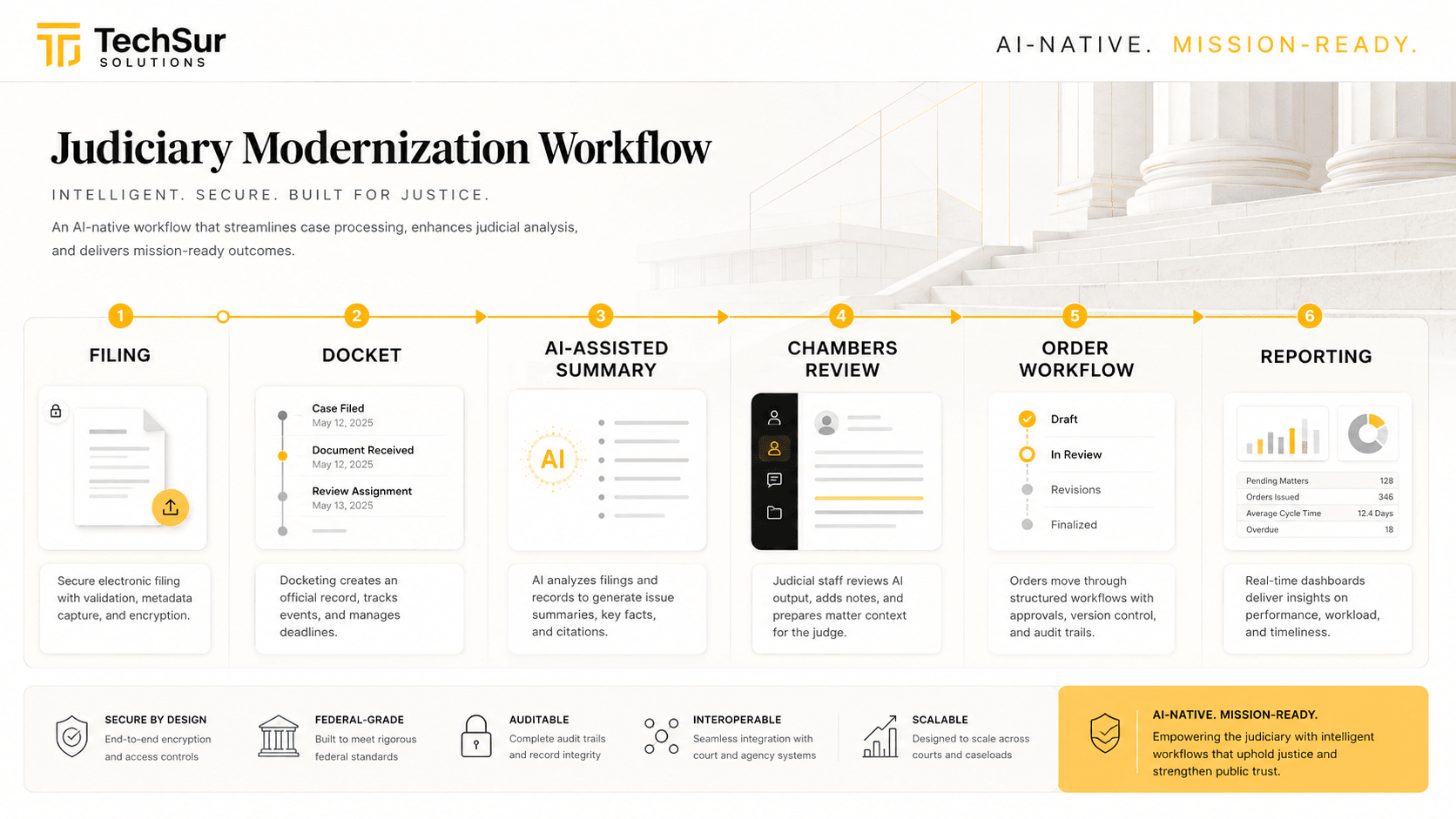
One substrate. Six stages. Six agents.
Each stage has a named agent with a defined scope, a documented prompt, and an evaluator-readable audit log. Humans approve every state transition.
Map current docketing, summarization, and chambers workflows, identifying AI-ready tasks before writing a line of code.
Structure case data, filings, and docket events for AI processing, including normalization across jurisdictions and case types.
Configure summarization, classification, and extraction models for court document types, tuned to the language and structure of federal filings, not generic legal text.
Integrate AI outputs into existing case management systems. Judges and clerks see AI-prepared summaries and classifications in the tools they already use.
Establish human review checkpoints and accuracy thresholds before production deployment. No AI output reaches chambers without validation against court-specific document types.
Monitor model performance, retrain on new document types, and expand to additional workflow steps. Capability compounds as the system learns the court's document corpus.
End-to-end, before and after.
What the mission flow looks like once this solution is in production. AI accelerates the work; humans decide the outcomes.
Five layers. Built on the Engine.
A reference architecture every program inherits. Tenants override where they need to; defaults are evaluator-ready.
Bring us the mission blocker.
Leave with a 90-day path.
Capability briefings are working sessions, not pitches. Tell us where you're stuck; we'll show you the lane, the accelerators, and the proof.