
Today’s DevSecOps landscape faces challenges with point-to-point integrations and fragile connectors. Each new tool requires custom scripting, manual upkeep, and constant debugging. A single, standard event protocol can simplify this complexity, allowing every commit, ticket update, build result, and deployment trigger to communicate seamlessly through a central event bus.
Standardize Once, Integrate Everywhere
By defining a universal event schema that includes code pushes, issue transitions, build statuses, and deployment events, teams can eliminate numerous bespoke integrations. Any tool that emits or consumes events according to this protocol can be integrated instantly.
With every action published to the same event stream, policy checks, compliance audits, and release gates can be managed from anywhere. This eliminates the need for copying logic across Jenkins files or custom webhooks, as automation is driven by reusable, protocol-driven workflows.
A unified protocol allows teams to focus on innovation rather than integration.
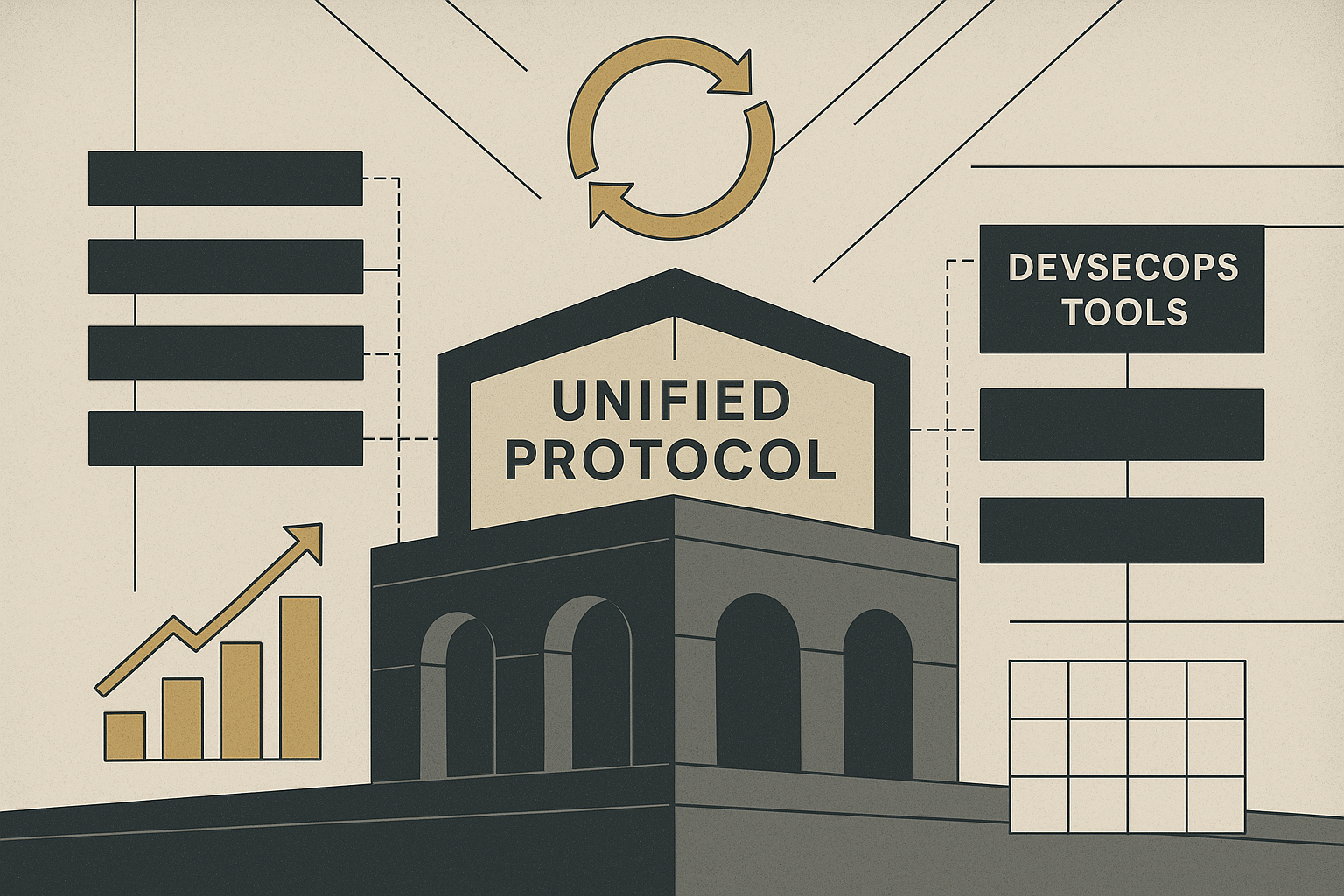
Holistic Visibility & Analytics
A unified protocol serves as a single source of truth. Security, quality assurance, and product teams can subscribe to the events they need, feeding them into analytics engines or AI pipelines. This approach surfaces cross-tool insights, such as churn hotspots or risky deployments, without the need for manual data stitching.
To begin, configure critical tools like Git, Jira, and Jenkins to emit standardized protocol events. Pilot a cross-tool workflow, such as auto-approving a release when all tests pass and no high-severity bugs remain, to demonstrate value before scaling.

Future Integration Simplified
In the future, adding a new tool to your DevSecOps environment could be as simple as connecting it through a shared protocol, eliminating the need for custom scripts and reducing maintenance backlogs.
As teams adopt this universal backbone, they can shift their focus from 'wiring tools together' to 'driving innovation,' accelerating delivery pipelines and allowing DevSecOps to concentrate on building rather than maintaining integrations.